
LoA Institute

Research Communication Program

Turn insights into impact

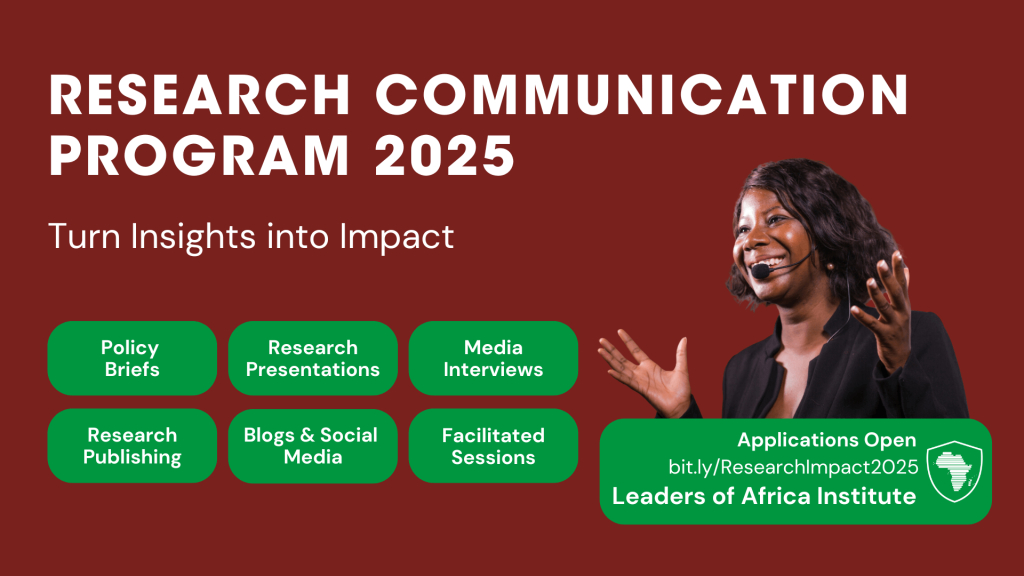
The Research Communication Program (RCP) is a flagship program of the Leaders of Africa Institute. The ability to effectively communicate research findings is more critical than ever. As society faces complex challenges — from climate change and public health crises to social inequality and technological innovation — research has the potential to drive meaningful change. The impact of research depends not just on the quality of the work, but on how well it is communicated to those who can act on it. The Research Communication Program equips researchers, faculty, practitioners, and advocates with the skills and strategies needed to effectively communicate their research and findings to a variety of audiences, including academic peers, policymakers, and the general public. The program is open to all fields from public health to social science and is in a live virtual format accessible anywhere. The program covers best practices for writing research briefs, creating policy memos, and engaging with media, as well as techniques for presenting complex information in an accessible and impactful way.

Past and Present Research Communication Program Scholars & Fellows​

About the Program

The Research Communication Program offers Scholars essential skills for effectively communicating their research, including preparing research articles, crafting policy briefs, delivering impactful presentations, participating in media interviews, facilitating panels and webinars, writing engaging blog posts and social media articles, and developing a strong research profile to enhance visibility and professional opportunities. The program offers instruction in using helpful software and tools including Overleaf/ LaTeX, Canva, Wix and WordPress, Google Analytics, DaVinci Resolve, CapCut, Open Broadcaster Software and production tools, and interactive presentation platforms to streamline research communication efforts. Research Communication Scholars will learn how to tailor their messages for different stakeholders, develop clear and compelling narratives, employ various communication channels, and measure the impact of research communication efforts.

Important Dates & Info

Applications Open: September 4, 2025

Applications Close: October 10, 2025

Program Dates: November 2025 – January 2026 with Continuing Mentorship

Program Format:

Live Virtual Cloud Classroom (~ 3 hours per week) and Individual Meetings with Professors

Features

Audience Analysis and Strategy

Understanding your audience is crucial for effective communication. This skill involves identifying the needs, interests, and knowledge levels of different stakeholders, such as academic peers, policymakers, or the general public. Scholars will learn how to tailor their messages to resonate with each audience, ensuring that their research is relevant and accessible. By mastering audience analysis, researchers can maximize the impact of their work, making it more likely to influence decisions, spark dialogue, and foster meaningful change. Scholars will also learn how to measure and evaluate the impact of research communication efforts with tracking and analytics, such as Google Analytics.

Storytelling Techniques

Research is more impactful when it tells a compelling story. This skill focuses on crafting narratives that make research work and findings memorable and engaging. Scholars will learn how to highlight key messages, use vivid examples, and create a logical flow that guides the audience through complex information. Effective storytelling can transform data and results into a narrative that captures attention and conveys the significance of the research, making it more relatable and persuasive across various audiences. Scholars will also learn how to tell their story as a researcher and craft a portfolio website using Wix and WordPress.

Policy Communication

Translating research into actionable insights for policymakers requires a specific set of skills. Scholars learn how to create clear, concise policy briefs and memos that distill complex research into practical recommendations. Scholars will also explore how to structure their communications to align with the policy process, addressing the needs of decision-makers and ensuring that their research can inform and influence policy debates. This skill is essential for researchers aiming to make a tangible impact on public policy.

Media Engagement

Engaging with the media is a powerful way to amplify research findings and reach a broader audience. This skill involves understanding how to work with journalists, craft press releases, and give effective interviews with expert public speaking skills. Scholars will learn techniques for simplifying complex information, framing research in ways that appeal to media outlets, and managing public communication during crises or high-stakes situations. Mastering media engagement allows researchers to raise the profile of their work and contribute to public discourse.

Visual and Multimedia Communication

Visuals can make research more accessible and engaging. This skill focuses on designing impactful graphics, infographics, videos, formatted papers, and presentations that effectively convey key research messages. Scholars will learn principles of visual design, including how to use color, layout, and data visualization tools to enhance comprehension and retention. By developing strong visual communication skills, researchers can create materials to inform and captivate their audience, making complex ideas easier to understand and remember. The program offers instruction in using helpful software and tools including Overleaf/ LaTeX, Canva, DaVinci Resolve, CapCut, Open Broadcaster Software and production tools, and interactive presentation platforms to streamline research communication efforts.

Personal Mentorship

The program offers mentoring and a personalized relationship with instructors. The program also offers a framework for international networking and building research relationships that span the globe. Scholars will also have access to the Leaders of Africa Institute’s professional network.

Benefits & Qualifications

Official LoAI Certificate

Professional Research Profile

Portfolio of Research Communication

Reference Letter (If Required)

Application Requirements

To complete the application, you will need the following materials:
  • Curriculum vitae/ resume (one PDF of up to 5 MB)
  • Statement of Interest (500 words maximum). Your Statement of Interest should include:
    • What are your research, thematic, and professional interests and relevant professional background?
    • What shaped your interests?
    • What do you hope to learn from the Research Communication Program at the Leaders of Africa Institute?
    • How will the Research Communication Program help you achieve your career and educational goals?
The deadline for applications is Friday, October 10th 2025.

Frequently Asked Questions

The advanced Research Communication Program is open to all fields and from all countries internationally.
Leaders of Africa Institute virtual course programs have a competitive application process. We have an Admission Committee that carefully reviews all applications and selects prospective Scholars with the best chance of success in the program. Scholar cohorts are purposely designed to be a size conducive to forming relationships with professors because we feel that this is important for mentorship and support.
Our application ensures that you are eligible to participate in our programs. It also allows us to know about your academic and relevant work experiences, as well as what you expect to gain by taking courses and experiencing our mentorship. We want to get to know you so that we may serve you. Carefully answer all of the application prompts fully and directly. If you have any questions about the program and application, reach out to us via the website chat or at institute@leadersofafrica.org.
The total tuition for the program is 3,500 USD. However, every accepted applicant receives an automatic Impact Scholarship worth approximately 3,200 USD. This leaves only a small fee of 250 – 350 USD for the program. In select cases, the fee may be paid in two installments to accord with your budget. The fee is only used to provide the Institute with the necessary technological resources to support the Scholars.

Leaders of Africa
Institute

Inquiry + Creative Expression